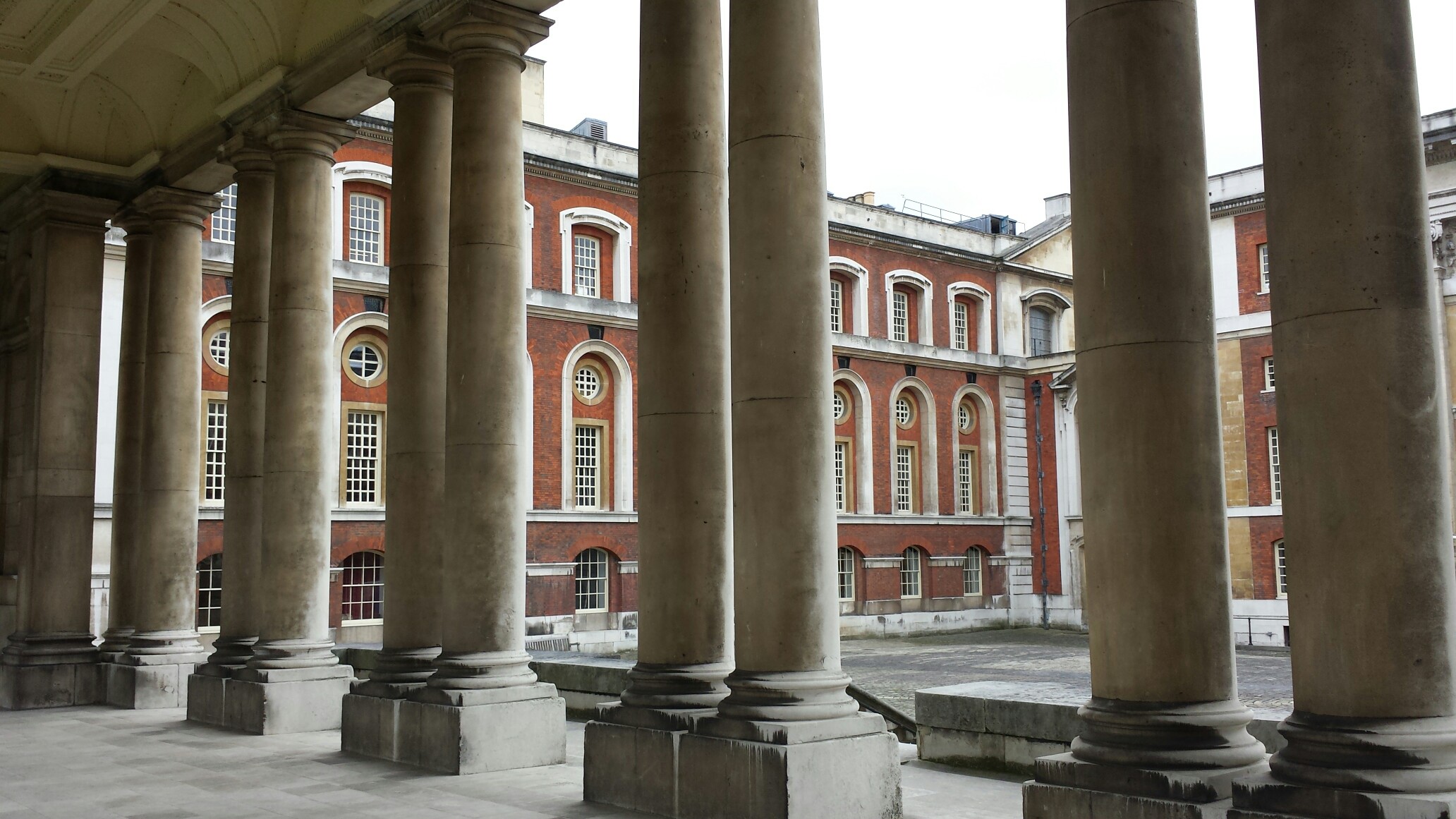
View from the Admiralty Buildings, Grenwich
View from the Admiralty Buildings, Greenwich (22 Mar 2015)

Despite it’s controversial history and, some might argue, “dodgy” financial underpinning, I can’t help but admire Greenwich.  It’s a part of London relatively untouched by the progress of time; where the city-at-large surrounding it has left it be, as a kind of comforting “nod” back to its imperial glory.

These days, of course, it’s not the done thing to refer to the British Empire as glorious.  Oh no, that’s far, far too politically incorrect.  Instead, we must loosely use in reference words such as “enslaving”, “pillaging”, “disempowering”  and, simply, “colonising”.

Such are the mists of time, allowing us  now to moralise on a spirit of adventure and exploration, taking for granted that the world is now known, the risk of travel is small and our collective enlightenment a “given”.

Yet I pause for thought when considering the next leap into the unknown – space, and what harvests me may assume ours to take and do with as we please.

If ever there was a time to unify people towards common goals, for the betterment of us all, now is it.

    Despite it’s controversial history and, some might argue, “dodgy” financial underpinning, I can’t help but admire Greenwich.  It’s a part of London relatively untouched by the progress of time; where the city-at-large surrounding it has left it be, as a…

http://stevedowe.me/2015/05/greenwich-time.html

I’ve decided I need to dance more in my life.  Being a techy-programmer-web_developing-CEO-type, there is so little time anyway.  With the remainder, I usually indulge in sci-fi, walking the dog, eating… and occasionally sleeping too.  Yet, being almost an artificial intelligence by any reckoning, I can tell you that Androids are too busy to dream.

Well, this has to stop!  No more sleeping!  Only raving.  It’s essential.

A trip to Miami is essential too.  After all, you can’t be all the time!

For those who value freedom.

I was lucky to have spotted a recent social media post, alerting me to showings of CITIZENFOUR in London over the past weekend. CITIZENFOUR, in case you are not aware, is a film made by celebrated filmmaker Laura Poitras (Praxis Films), who accompanied journalists Glenn Greenwald and Ewan MacAskill to Hong Kong to interview Edward Snowden in the summer of 2013.

My partner and I took a train to Wimbledon. It was an uncharacteristically warm day, summer-like in all regards except the browning of the leaves. The trees looked tired as we marched along to the station; we weren’t missing this film for anything.

In contrast to the anticipation building up inside of me, waiting to see this film, Wimbledon itself was very ordinary. People going about their normal lives. Appetizing whiffs of just-cooked food were wafting over from the market stalls. Traffic was permanently in a hurry with barely any regard for pedestrians’ safety. And the shoppers held an equally high regard for the traffic too, voluntarily stepping out in front of anything coming.

And the shoppers …
voluntarily stepping out in front of anything coming.

The matinée showing at the bijou HMV Curzon cinema was starting just after lunch. I wanted to get there early so that, in anticipation of the queues, we would be assured of a good seat. When picking up our tickets, we spoke to a member of staff behind the bar/counter about the expected numbers.

Staggeringly, four seats had been booked. Including ours. Citizens: four.

To my slight relief, more than four people eventually turned up and attended the showing. Twenty, maybe. Perhaps thirty, tops. In a 110-seat room. And they were comfortable seats too. The best you’d find in any cinema, with lots of leg room and deep, comfortable cushions.

A Tale of Two Cities

After reading Lawrence Lessig’s blog post of his recent cinema outing in Cambridge, Massachusetts, with 500 movie-goers attending their picture house, I wondered how there could be such disparity across the pond. For us, there was no line to stand in before entering, and perhaps adding insult to injury, our tickets were not even checked by a member of staff when we walked in to pick our (unallocated) seats.

Perhaps it was the over-air-conditioned screen that turned people away. Considering that outside it was the very end of the British summer and we saw temperatures of 20 deg C, inside was another story altogether. We were lucky if it was more than 14. But I don’t think this was the reason for the poor turn-out; any evidence of forward-thinking would surely have improved the attendance?

What does this say about continued British apathy towards such fundamental issues?

A somewhat senior lady who attended the film, mentioned to me on her way out, “I don’t think I meant to come and see that. I thought it was something else.Citizen Kane, perhaps? I hope she wasn’t one of the original four who bought in advance…

Perhaps people felt it was a story already told. In some ways it was – but arguably, in many ways the whole story had not been told until now. A couple of reveals towards the end of the film were new information to me. Stuff I wasn’t aware of, from reading the Snowden book.

The Wombles

I am glad that a healthy number of people in the US are curious about this subject and decided to explore it further. You might expect this from the residents of Cambridge (Mass.), with its connection to Free Software and socio-political activism, and well done to them.

So, a quick glance at the population numbers of both areas provides some fairly meaningless stats on which to close.

Cambridge’s popn = 107,000 or so. Wimbledon’s: around 60,000.  Roughly speaking, for every 214 residents in Cambridge, one person attended Saturday’s matinée there. Only one person of every 3,040 in Wimbledon managed the same feat.  What does this say about continued British apathy towards such fundamental issues?

I am left feeling that provided Centre Court and strawberries are always available, Wimbledon won’t care much.  Unless, of course, someone personally has an infraction with the law, as a result authoritarian paranoia.  Then, perhaps, it might fill a column in page 7 of the local rag.  Residents might even chat about this at a local pub, in-between opinions on the state of the brew.

But to complain against wrongdoings is normal.  It’s human nature to focus on the oppressors rather than the oppressed.   Luckily, for us, in respectable communities there still burns a glimmer of hope that sense may prevail.

This is a remarkable story of how restoring some balance in nature can have hugely positive ecological effects.

From: http://themetapicture.com/when-they-brought-these-wolves/

“In 1995, wolves were re-introduced into the Yellowstone National Park, after being wolf-free for 70 years. What naturalists and biologist never imagined, was that the most remarkable thing would take place.”

It is remarkable indeed, and so elegant in demonstrating how nature should be respected if the world as we know it is to survive.

In the spirit of the upcoming Hallo’ween, today is my unofficial .  I am challenging myself to go without using my computer mouse all day – which has already been a considerable challenge in WordPress when creating this post.

The mouse is dead!
The mouse is dead!

(img: http://funnypictures24.blogspot.co.uk/2012/02/computer-mouse-humor-best-computer.html)

Let’s see how far I get…

If it hasn’t been said enough times already, let it be said once more: Emacs and org-mode are quite probably the best way ever to organise your personal life.

Emacs, for starters

Emacs as a text editor is rock solid. If you have a computer where you type in text and which:

  • is web based (e.g. a chromebook)
  • has any kind of touch interface (a tablet, phone)
  • is running a heavy GUI (graphical user interface)

.. then you are certain to observe a certain lag on input. It might be very slight, but it will likely be there. I know this to be the case for many devices out there, even those which purport to be “high-end”.

With Emacs, there seems to be a much more direct connection to the keyboard: you type, text appears. You type faster, text appears faster. In fact, text is capable of appearing much more quickly than you can possibly type. This makes blogging quick and painless.

org-mode, for main course

Life in Emacs simply came to be, through org-mode. Emacs itself is amazing; org-mode made organising data even better. A quick refresher:

  • org-mode creates everything in plain text, for maximum portability between systems
  • it is known as an “outline mode” enhancement for Emacs, meaning it helps to display semi-structured text effectively
  • it allows for the creation of lists – of projects, tasks, notes, links … you name it, anything that can be represented in text
  • it is portable, allowing for synchronisation with mobile devices
  • using Emacs, it is powerful – allowing org-mode notes to interact with other aspects of Emacs
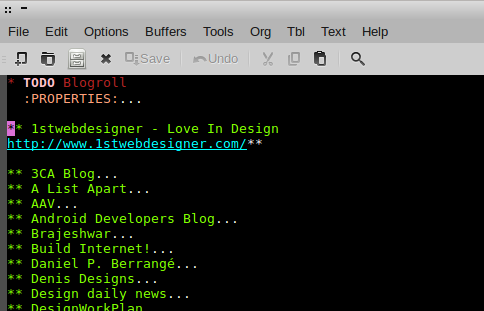
image of org-mode
org-mode in action: showing a list of links

Org-mode also supports all sorts of fancy formatting and customisation, meaning text can look good and be easy to follow.

org2blog, for desert

What would all this power be for, unless blogging! 🙂

Actually, blogging is just one activity which benefits greatly from the power of org-mode, as org’s powerful and easy formatting options are seamlessly translated into HTML and published to a blog.

In my case, I’m using a WordPress site. I create a new post using the commands

M-x org2blog/wp-login
M-x org2blog/wp-new-entry

I then type in my post and save it to a local file, using

C-x C-s

and then post it to WordPress for subsequent tweaking, with

M-x org2blog/wp-post-buffer

I can then add some final polish and check the format in WordPress before final publishing.

As a demo and an indication of speed, this blog post took only 5 minutes to write, post, edit and publish.

I am the first to admit that I am a product of the old guard.  What do I mean by this?  Well, when I started running a business in 2001, when the internet provided unbridled commercial opportunities and there was a scarcity of talent to develop for them, there was a certain modus operandi: keep your cards close to your chest.  Shedding this behavioural axiom feels like the equivalent of standing up naked, in front of a live TV audience, promising them you really are still going to the gym and it’s all a work in progress.  You can expect mixed reactions.

But in the last thirteen years, a lot has changed.  We have seen the meteoric rise of internet-enabled devices and the framework, especially via social networking, for people to express themselves more freely.  In fact, not just “more” freely, but FREELY, period.  With this certain stream-of-consciousness we have also seen how businesses, once the “big blue”s of this world – hidden behind glass and steel, dictating the new world order – have become much more bottom-up, and even grassroots in appearance, if not in total nature.

I would argue that smaller teams in larger businesses will become more fashionable, because they tend to get things done more efficiently.  The challenge has become less about the big wins, and more about how the small, inter-connected wins can be made to work well together.  This, after all, was the original spirit of Web 2.0 (remember that?!).  What Web 2.0 represented was the idea that instead of developing a monolithic web site or business platform which covered all functionality, you could actually interact with other sites and use them too.  And they could use you and your services/data.

This is very much the case today.  How many web sites do you visit where you can log in using credentials from another service/site? This flexibility and openness is not necessarily less secure, though some might argue against global logins – and there are good reasons to be cautious of this.

But, authentication is one of many possible services available on the web, and exploring this loosely-coupled architecture is becomming faster and easier than ever. Through a much greater spirit of discovery, we are bearing witness to an age of more open experimentation, more open discussion, and more open engagement amongst interested parties.  Clients, friends, rivals, competitors.   Finally, we can also celebrate the “failures” too.  The increasingly scientific nature of modern thinking allows egos to be left at the door, and the excitement and joy of new adventures in technology to be more fully appreciated.

Many of us are into technology because of this excitement and enlightenment, myself included.  It’s childlike and, IMHO, a desirable quality in a person.  When you accept you are but one person, you accept a universal truth shared by everyone – and in so doing, acknowledge that while your time is precious, sharing whatever you can from it is a great investment.

On that basis, I am intending to up my blogging rate ten-fold, to try to document the events of my days and weeks and the challenges I face in them.  My experiment will be to see if in doing this – i.e. openly blogging much more of what’s going on in my microbusiness, there is a positive effect on people around, the interest in my business services and, ultimately I suppose, a positive effect on me.

And I will be open about the result.  Stay tuned!

Chromecast: the promise of simplicity

Not getting audio-only output from your Chromecast?  Why not just plug it in the wrong way round… Read on!

For helping a senior family member switch from a faulty Linux laptop to a Chromebook, I was rewarded with a Chromecast (thanks Mum). Lucky me.

The plan, with my newly received gift, was to plug the Chromecast into a spare HDMI input on my Sony STR-DA1200ES A/V amplifier and enjoy listening to my Google Play Music collection, or watch some YouTube videos, as desired. My (naive) idea was that because I had HDMI into the amp, I could just enjoy the music without having my Panasonic TX-P42G10B Plasma TV switched on.  Oh no.  How wrong I was.

Simplicity, redefined

The first issue, which I quickly discovered, is that HDMI and other digital display protocols like Thunderbolt, Digital Video Interface (DVI) and DisplayPort (DP) operate in full cooperation with DRMDigital Restrictions Management.  By using a sub-protocol called HDCP – or High-bandwidth Digital Content Protection, the source device negotiates an encrypted link with the receiving device – typically your TV.   The data then travels down (or up) the HDMI link “safely”, protected from digital content thieves, pirates, bittorrent users.. you know the sort: me and you.  The customers.

An HDMI splitter: the ViewHD

But arguments aside about what rights one should have with the digital media  they purchase, the reality is that the technology actually introduces more complexity and less convenience than promised.

The situation is made worse with how HDMI can be implemented.  You can have end points – a source and a display device, for instance – and you can also have mid-point, passthrough devices.  But when it comes to HDCP, pass-through devices have no say or influence over content encryption or negotiation – they just shunt the data onwards down the chain. HDMI splitters and strippers were introduced as another way of getting around implementation restrictions – including removing DRM, with varying results (HDCP, HDMI splitters/strippers and Chromecasts have been discussed on reddit more than once, not to mention XDA developers and other sites…). [ Incidentally, a highly regarded device, the HD Fury, won’t give you much change from £150-odd, but it is reputedly very good as totally stripping HDCP. ]

Dancing in the streams

DRM is an issue that will not go away, because we get back to the basic fact that controlling users through draconian methods of control only punishes innocent consumers, while not providing any tangible security benefit for the media plublishers.

So we arrive back at my Chromecast.  Through a number of unplugging and re-plugging efforts, I stumbled upon a strange solution.  I acquired the ViewHD HDMI splitter, with the intention to split out audio from HDMI and feed an TOSLink optical cable into the A/V amp, but even using this required the TV to be switched on.

System singing sweetly: audio in full swing

But… what if the Chromecast thinks it is sorted with its display device?  Strangely, this seems achievable by plugging the Chromecast into the HDMI splitter’s HDMI input, and then plugging the HDMI splitter’s output into the A/V amp’s output.  Yep, let me repeat: connecting the HDMI splitter’s output to the amp’s output connector (which would normally go to a monitor) strangely seemed to fool the Chromecast into happily sending forth its content to the HDMI splitter, from which the optical feed supplies PCM audio at 48khz straight into the amp.

Selecting music, using Google Play Music on the Nexus 7 Android tablet, is now a joy that is almost completely reliable.  Occasionally it reports that a track cannot be played, which requires disconnection of tablet from Chromecast and re-connection while playing the song.  But send the Chromecast an album or playlist, and all’s good.

Conclusion

The downside of this strange result is that I can only use the Chromecast for one thing: streaming audio.  Luckily, this is the only reason I go it, and the devices are so cheap (£30) as to effectively justify buying a second for the same TV, using another spare HDMI input.

Why the Chromecast and ViewHD behave quite like this, I cannot say.  It suggests there could be other interesting workarounds with HDMI and various signal splitting devices .. but this is probably where I should end.